
Exploring Substances: Acidic, Basic and Neutral
Learn how to classify everyday substances as acidic, basic, or neutral using indicators, and understand what happens when acids and bases react together.
Chapter Snapshot
- Substances can be classified as acidic, basic, or neutral based on their chemical nature.
- Acids taste sour, while bases usually feel soapy and taste bitter.
- Indicators are substances that change colour to show whether a substance is acidic or basic.
- Litmus, turmeric, and china rose extract are common natural indicators.
- Neutralisation occurs when an acid and a base react to cancel each other's effects.
- Salt and water are typically formed as products of a neutralisation reaction.
- Many household items, such as lemon juice, vinegar, soap, and baking soda, are acidic or basic.
- Acids and bases must be handled carefully because concentrated forms can be corrosive.
What You Will Learn
- Classify given substances as acidic, basic, or neutral
- Describe the general properties of acids and bases
- Explain the role of an indicator in identifying acids and bases
- Prepare and use natural indicators such as turmeric and red cabbage extract
- Describe the colour changes shown by litmus, turmeric, and china rose indicator
- Explain the process and importance of neutralisation
- Identify acidic and basic substances used in daily life
- Follow safety precautions while handling acids and bases
Chapter Overview
Lemon juice tastes sour, soap feels slippery, and baking soda can settle an upset stomach. These everyday experiences are all connected to a basic chemical idea: substances can be classified as acidic, basic, or neutral depending on their chemical properties. This classification is not just useful in a laboratory; it explains many things we encounter daily, from the taste of fruits to the working of antacid tablets.
In this chapter, students will learn how to test whether a substance is acidic, basic, or neutral using simple tools called indicators, and how acids and bases react with each other in a process called neutralisation. Building this understanding helps explain many familiar phenomena, such as why a bee sting is treated with baking soda or why farmers sometimes add specific substances to soil.
Prerequisite Knowledge
- Familiarity with common kitchen substances such as lemon, vinegar, baking soda, and salt.
- Basic understanding that different substances have different physical and chemical properties.
- Awareness of simple safety practices while handling substances in a science laboratory.
Key Concepts
Key Terms
Detailed Explanation
1. Acidic, Basic, and Neutral Substances
Substances around us can be grouped into three broad categories based on their chemical nature: acidic, basic, and neutral.
Common Acidic and Basic Substances
- Acidic: lemon juice, vinegar, curd, tamarind, orange juice, an ant's sting fluid.
- Basic: soap, baking soda solution, lime water, washing powder, toothpaste.
- Neutral: pure water, common salt solution, sugar solution.
Show answer
2. Indicators: Detecting Acids and Bases Safely
Since tasting or touching unknown substances is unsafe, scientists use special substances called indicators to identify whether a substance is acidic or basic.
Litmus: The Most Common Indicator
Litmus is a natural dye obtained from lichens and is commonly available as litmus paper or litmus solution.
Effect of Acids and Bases on Litmus
| Litmus Type | Effect of Acid | Effect of Base |
|---|---|---|
| Blue litmus paper | Turns red | Remains blue |
| Red litmus paper | Remains red | Turns blue |
| Neutral substance | No colour change in either litmus paper | No colour change in either litmus paper |
Natural Indicators
Apart from litmus, several natural substances also act as indicators.
- Turmeric: Turns from yellow to reddish-brown in the presence of a base, and shows little change with acids.
- China rose (Gudhal) extract: Turns magenta or pink with acids and green with bases.
- Red cabbage extract: Changes to a reddish or pink shade with acids and a greenish or yellowish shade with bases.
Olfactory Indicators
Some substances change smell rather than colour in the presence of acids or bases, and are known as olfactory indicators.
Show answer
3. Neutralisation Reaction
When an acid and a base are mixed in suitable amounts, they react with each other and cancel out each other's properties. This important chemical process is called neutralisation.
This reaction can be represented in words as:
Acid + Base → Salt + Water
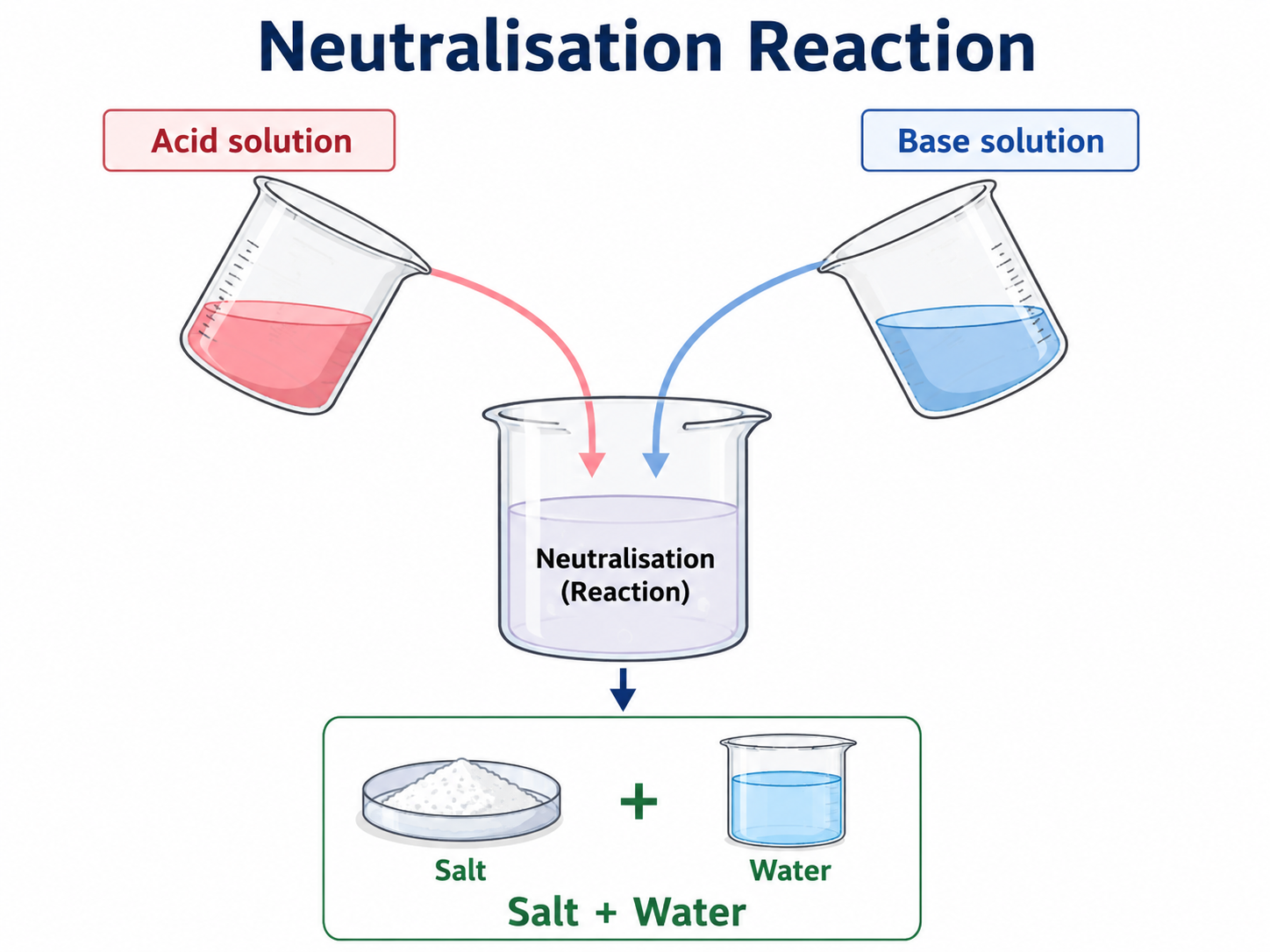
When a person experiences acidity due to excess acid in the stomach, an antacid tablet, which is mildly basic, is taken to neutralise the extra acid and provide relief.
Everyday Applications of Neutralisation
- Ant and bee stings: The fluid injected during an ant bite is acidic, so applying a mild base such as baking soda paste helps reduce the irritation.
- Wasp stings: The fluid injected is basic, so applying a mild acid such as vinegar can help relieve discomfort.
- Soil treatment: Farmers add basic substances, such as slaked lime, to acidic soil to make it more suitable for growing crops.
- Factory waste: Basic substances are sometimes added to acidic factory waste before releasing it into water bodies, to reduce harmful effects on aquatic life.
4. Handling Acids and Bases Safely
Some acids and bases used in laboratories are concentrated and corrosive, meaning they can damage skin, clothing, and other materials on contact.
Show answer
Investigation
Aim
To prepare a natural indicator using red cabbage and use it to test common household substances.
Materials
- A few red cabbage leaves
- Hot water (handled by an adult)
- A strainer
- Small transparent cups
- Household substances such as lemon juice, soap solution, vinegar, and baking soda solution
Procedure
- With adult supervision, tear red cabbage leaves into small pieces and soak them in hot water for about fifteen minutes.
- Strain the liquid into a container; this purple liquid is the red cabbage indicator.
- Pour a small amount of the indicator into separate cups containing lemon juice, soap solution, vinegar, and baking soda solution.
- Observe and record any colour change in each cup.
Observation
The indicator generally turns pink or red in acidic substances such as lemon juice and vinegar, and turns green or blue-green in basic substances such as soap solution and baking soda solution.
Conclusion
Red cabbage extract acts as a natural indicator, showing different colours in acidic and basic substances, which allows household substances to be classified without tasting or touching them directly.
Fair Test
The same volume of red cabbage indicator was added to each substance under similar conditions, so that any difference in colour change could be linked to the acidic or basic nature of each substance rather than to the amount of indicator used.
Exam Focus
Show answer
Common Mistakes
Quick Revision
Quick Revision
- Acid: Turns blue litmus red; generally sour in familiar food substances.
- Base: Turns red litmus blue; generally bitter and soapy to touch.
- Neutral substance: Does not change the colour of litmus.
- Indicator: A substance that changes colour or smell to show whether a substance is acidic or basic.
- Litmus: A natural dye obtained from lichens, used as a common acid-base indicator.
- Turmeric: Turns reddish-brown in the presence of a base.
- China rose extract: Turns magenta with acids and green with bases.
- Olfactory indicator: Changes smell rather than colour in acidic or basic conditions.
- Neutralisation: Reaction of an acid with a base to form salt and water.
- Corrosive substance: A substance that can damage skin or materials on contact.
- Antacid: A mild base used to neutralise excess acid in the stomach.
- Safety: Never taste or smell unknown laboratory substances directly.
Practice Questions
Which colour change occurs when blue litmus paper is dipped in an acidic solution?
A. Remains blue B. Turns red C. Turns green D. Turns colourless
View Solution
Correct Answer: B
Blue litmus paper turns red when dipped in an acidic solution. This is one of the standard tests used to identify acids.
Which of the following is a natural indicator?
A. Phenolphthalein B. Methyl orange C. Turmeric D. Universal indicator paper
View Solution
Correct Answer: C
Turmeric is a natural indicator obtained from a plant source, whereas phenolphthalein, methyl orange, and universal indicator paper are synthetic indicators prepared in laboratories.
The products formed when an acid reacts completely with a base are:
A. Only water B. Only salt C. Salt and water D. Salt and an acid
View Solution
Correct Answer: C
A neutralisation reaction between an acid and a base produces salt and water as the main products.
Which substance would most likely be used to relieve the irritation caused by an ant bite, which injects an acidic fluid?
A. Vinegar B. Lemon juice C. Baking soda paste D. Orange juice
View Solution
Correct Answer: C
Since the ant bite injects an acidic fluid, applying a mild base such as baking soda paste helps neutralise the acid and reduce irritation.
Red cabbage extract is added to an unknown solution and turns green. The unknown solution is most likely:
A. Acidic B. Basic C. Neutral D. Cannot be determined
View Solution
Correct Answer: B
Red cabbage extract typically turns green or greenish-blue in the presence of a basic substance, so the unknown solution is most likely basic.
Define an indicator.
View Solution
Model Answer
An indicator is a substance that changes colour, or in some cases smell, when it comes into contact with an acidic or basic substance, allowing the substance to be identified safely.
Name two natural indicators.
View Solution
Model Answer
Turmeric and china rose (Gudhal) extract are two examples of natural indicators.
What colour does red litmus paper turn in the presence of a base?
View Solution
Model Answer
Red litmus paper turns blue in the presence of a base.
Explain why taste should not be used to test unknown laboratory substances.
View Solution
Model Answer
Taste should not be used to test unknown laboratory substances because many acids and bases can be corrosive, toxic, or harmful if they come into contact with the mouth. Safe methods, such as using indicators, must be used instead to identify whether an unknown substance is acidic, basic, or neutral.
Describe the neutralisation reaction with a suitable word equation.
View Solution
Model Answer
Neutralisation is the reaction between an acid and a base in which their acidic and basic properties cancel out, producing salt and water. This can be represented as: Acid + Base → Salt + Water. For example, when an antacid neutralises excess stomach acid, the acidic effect is reduced, providing relief from acidity.
Why is a farmer advised to add slaked lime to acidic soil?
View Solution
Model Answer
Slaked lime is a basic substance, so adding it to acidic soil helps neutralise the excess acidity of the soil. This creates more suitable conditions for the healthy growth of crops that do not tolerate highly acidic soil.
Describe an activity using turmeric paper to classify a set of household substances as acidic or basic, including your expected observations.
View Solution
Model Answer
Strips of paper can be soaked in a turmeric solution and dried to prepare turmeric indicator paper. Small amounts of household substances, such as lemon juice, soap solution, vinegar, and baking soda solution, can be applied separately to different turmeric paper strips using a dropper.
If the substance is acidic, such as lemon juice or vinegar, little or no colour change is expected on the turmeric paper. If the substance is basic, such as soap solution or baking soda solution, the turmeric paper is expected to turn reddish-brown. By comparing the colour change for each substance, they can be classified as acidic or basic, with substances showing no colour change treated as either acidic or neutral, which can be confirmed using an additional indicator such as litmus.
A person experiencing acidity is advised to drink a solution containing a mild base. Explain, using the concept of neutralisation, how this solution helps relieve the discomfort.
View Solution
Model Answer
Acidity occurs when there is excess acid in the stomach. A mild basic solution, such as one containing an antacid, reacts with this excess acid through neutralisation, forming salt and water and reducing the amount of acid present. This lowers the acidic effect in the stomach, which helps relieve the discomfort caused by acidity.
Explain why factories are often required to treat acidic waste water with a basic substance before releasing it into rivers.
View Solution
Model Answer
Acidic waste water released directly into rivers can harm aquatic plants and animals by disturbing the natural chemical balance of the water. By treating the acidic waste with a basic substance, a neutralisation reaction occurs, reducing the acidity of the waste water before it is released. This makes the water safer for aquatic life and helps protect the river ecosystem.
Apply Your Learning
At home, with the help of an adult, prepare a simple indicator using turmeric powder mixed with a small amount of water, or use pieces of turmeric-stained paper.
Then answer:
- Test the turmeric indicator with two safe household substances, such as soap solution and lemon juice, and record any colour changes observed.
- Based on your observations, classify each tested substance as acidic or basic.
- Explain why an indicator is a safer method of testing substances compared to tasting them.
Chapter Summary
Chapter Summary
- Substances can be classified as acidic, basic, or neutral based on their chemical properties.
- Acids turn blue litmus red, while bases turn red litmus blue; neutral substances cause no change.
- Indicators, such as litmus, turmeric, and china rose extract, safely reveal whether a substance is acidic or basic.
- Olfactory indicators change smell rather than colour in acidic or basic conditions.
- Neutralisation is the reaction between an acid and a base that produces salt and water.
- Neutralisation explains everyday situations such as treating ant stings and relieving acidity using antacids.
- Farmers use basic substances to neutralise excess acidity in soil, improving conditions for crops.
- Factories often neutralise acidic waste water before releasing it into rivers to protect aquatic life.
- Concentrated acids and bases can be corrosive, so safety precautions must always be followed.
- The pH scale, studied in later classes, provides a numerical measure of how acidic or basic a substance is.